
Beyond Bending Rules: Decoding "Jeitinho" and Global Relationship-Based Problem Solving

On July 8, 2026, I had the pleasure of facilitating a global cohort of intercultural professionals during our latest Culture Chat session. Together, we dove deep into one of Brazil's most fascinating, frequently misunderstood cultural frameworks: the concept of Jeitinho.
What began as an exploration of Brazilian navigation quickly opened up into a brilliant global mosaic. Our participants—connecting from France, Türkiye, India, Costa Rica, Canada, Portugal, Brazil, and the US—helped map out how different societies across the globe leverage relationships, creativity, and rules to solve problems.
Here is a breakdown of what we uncovered, and why decoding these hidden cultural mechanics is a vital asset for cross-border leaders.

The Dual Nature of Jeitinho: Light vs. Shadow
To truly understand jeitinho, you have to look past the superficial definition of "finding a way" and analyze its two distinct operational sides:
☀️ The Light Side
At its core, the positive side of jeitinho is driven by human warmth, empathy, and high-context flexibility. It represents a cultural willingness to accommodate an individual, go beyond standard expectations, and provide genuine help if the interaction is approached with kindness and mutual respect. It transforms a rigid system into an empathetic, human-centric interaction.
🌑 The Shadow Side
Conversely, the shadow side represents the tactical maneuvers required to bypass or bend cold, hyper-bureaucratic, and rigid institutional frameworks. When a system becomes too stark or dysfunctional to serve practical needs, jeitinho becomes the behavioral pressure valve used to navigate around those obstacles.
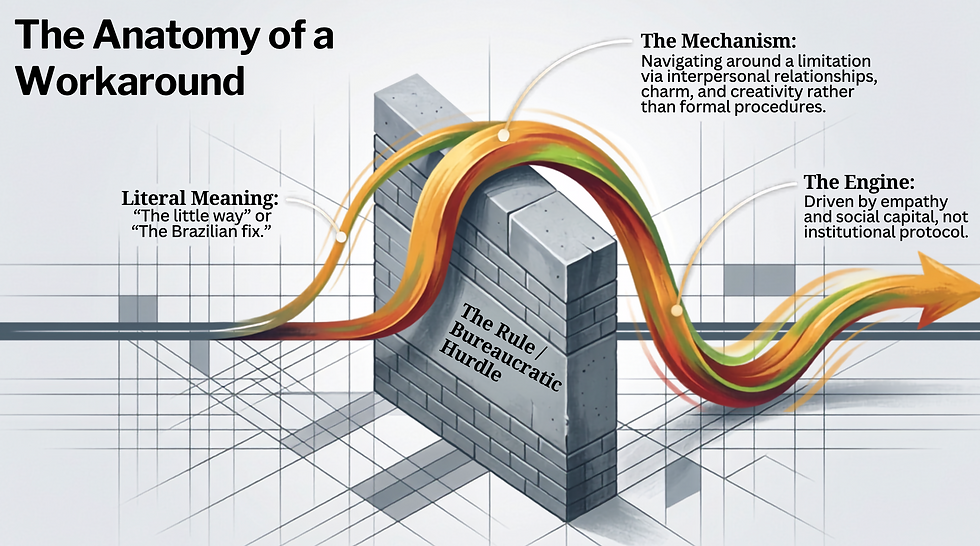
The Global Matrix of Relationship-Based Maneuvers
One of the most powerful realizations from our session is that jeitinho is not a isolated phenomenon; it is a human response to structural friction. Different cultures have developed their own highly specific vocabularies to describe the intersection of creativity, relationships, and rules:
Country / Region | Cultural Term |
Brazil | Jeitinho |
India | Jugaad |
Pakistan | Sifarish / Wasta |
Germany | Vitamin B |
Spain | Enchufe / Tener Padrino |
China | Guanxi |
Mexico | Un Favorcito |
Colombia and Venezuela | Palanca |
France | Système D |
USA | Pulling Strings |
The Executive Takeaway: High-Context vs. Low-Context Leadership
As our group analyzed these terms, an important pattern emerged connecting directly to Erin Meyer’s Culture Map framework: these relationship-based workarounds closely align with the divide between high-context and low-context communication styles, maybe?
"It seems Light Side corresponds with High Context and Shadow Side with Low Context style of interacting/communicating." — Culture Chat Participant
In highly regulated, low-context societies (like Finland or Germany), systems are designed so the individual has to do very little personal navigation—the rules are explicit, linear, and evenly applied.
However, in high-context or heavily bureaucratic markets, trust is not built through institutional efficiency; it is built through interpersonal investment. A leader who treats a relationship as an ongoing investment can successfully reap the benefits of flexibility, speed, and cross-border innovation.
When you understand the hidden rules that govern how a culture handles exceptions, you stop viewing friction as an obstacle—and start viewing Cultural Intelligence (CQ) as your ultimate operational strategy.
Did you miss this session? Our global Culture Chat community gathers regularly to decode cross-border leadership dynamics, build trust across borderless teams, and turn cultural friction into innovation. Stay tuned for our next virtual session schedule.


Comments